
What is the best temperature and humidity for dry aging beef?
Dry aging requires more than keeping beef cold. Temperature, relative humidity and airflow work together to influence moisture loss, aging conditions and the development of the finished product.
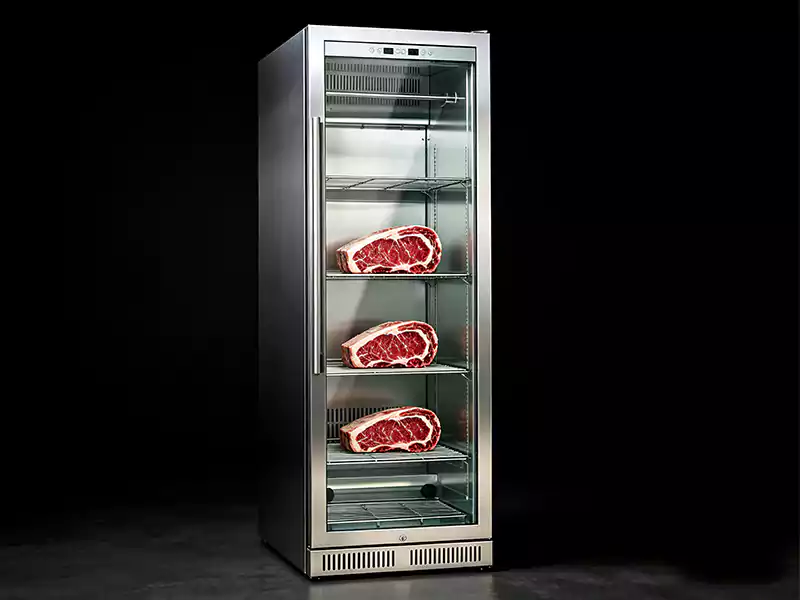
For commercial operations, selecting the right environmental settings is an important part of establishing a repeatable dry aging process. However, there is no single temperature and humidity combination that should be treated as universally correct for every cut, cabinet and aging program.
Industry research commonly describes dry aging under refrigerated conditions around 0–4°C (32–39°F), with relative humidity frequently in the 70–85% range. These are reference conditions reported in the literature, not a universal operating prescription. The appropriate settings depend on the equipment, the aging process and applicable food-safety requirements.
In this guide, we explain how temperature, humidity and airflow affect dry aging, what to consider when selecting a dry aging refrigerator, and why all three factors should be managed together.
What Is the Best Temperature for Dry Aging Beef?
Temperature is one of the most important variables in the dry aging environment because it influences refrigeration conditions and interacts with the other parameters involved in aging.
Research reviews commonly describe dry aging at refrigerated temperatures around 0–4°C (32–39°F). A review of commercial dry-aging practices also reported that beef is commonly aged at approximately 1–4°C, although actual conditions vary between facilities and processes.
Sources: Beef Research — Post-Mortem Aging and Microbiological Safety of Aged Meat.
Why Temperature Stability Matters
A displayed temperature is only useful when it accurately represents the environment in which the beef is held.
Commercial operators should consider:
- Whether the cabinet maintains stable operating conditions
- Whether the temperature sensor is positioned appropriately
- How frequently the door is opened
- Whether the cabinet is loaded in a way that restricts air circulation
- Whether the refrigeration system is operating as intended
- Whether temperature readings are recorded and reviewed
Frequent fluctuations or uneven conditions can make the aging environment less consistent. A dedicated dry aging refrigerator should therefore be evaluated for its ability to control and monitor the internal environment, not simply for its lowest available temperature.
Is a Colder Temperature Always Better?
No. Selecting the lowest available setting is not automatically the best approach.
Dry aging depends on a combination of temperature, relative humidity, airflow and time. Changing the temperature without considering the rest of the system can alter the overall process.
Operators should follow the equipment manufacturer’s instructions, a validated aging protocol and applicable local food-safety requirements rather than choosing a setting from a general online recommendation.
What Is the Best Humidity for Dry Aging Beef?
Relative humidity (RH) describes the amount of moisture in the air relative to the maximum amount that air can hold at a given temperature.
Humidity matters during dry aging because moisture gradually leaves the exposed surface of the beef. The surrounding environment influences how quickly this moisture is lost.
Published recommendations and experimental settings vary. Commercial-practice reviews commonly report relative humidity around 75–85%, while research studies have investigated a broader range of conditions.
Sources: Microbiological Safety of Aged Meat and Effects of Relative Humidity on Dry-Aged Beef Quality.
What Happens When Humidity Is Too Low?
Lower relative humidity can accelerate moisture evaporation, particularly during the early stages of aging.
This may increase early weight loss and affect the surface-drying process. However, the relationship between humidity, total moisture loss and finished product characteristics is more complex than assuming that lower humidity always produces a better result.
A 2024 study compared dry aging at 50%, 70% and 85% RH at 2°C for 42 days. Lower humidity accelerated moisture loss during the first three days, but the researchers did not find a significant difference in total moisture loss between the dry-aging humidity treatments. The 50% RH treatment also tended to be associated with more desirable flavor notes in that study.
These findings are specific to the experimental conditions and should not be interpreted as proof that 50% RH is the best setting for every commercial dry aging process.
Read the 2024 study on relative humidity and dry-aged beef.
What Happens When Humidity Is Too High?
Humidity must also be controlled at the upper end of the operating range.
Excessive moisture in the cabinet environment can affect surface drying and may contribute to undesirable microbial or product-quality outcomes, depending on the temperature, sanitation, airflow and other conditions.
The important point is not to assume that the highest possible humidity is best. Instead, the humidity target should be appropriate for the equipment, product and validated process.
Is There One Ideal Relative Humidity?
Current research does not establish one humidity setting that is best for every dry aging application.
The results depend on the experimental design and the combination of environmental conditions. Published commercial practices also vary.
For a professional operation, choose a dry aging refrigerator that can monitor and manage humidity appropriately, then determine the operating target from the equipment specifications and validated aging procedure.
Temperature vs. Humidity: Why Both Matter
Temperature and humidity should not be considered independently.
A dry aging cabinet may maintain its temperature while experiencing changes in humidity. Similarly, a humidity reading alone cannot tell you whether the whole aging environment is appropriate.
Both variables affect the conditions around the meat, and their effects also depend on airflow and time.
| Parameter | Its Role in Dry Aging | What to Monitor |
| Temperature | Establishes the refrigerated environment | Stability and recorded readings |
| Relative humidity | Influences moisture evaporation | RH readings and variation |
| Airflow | Distributes air around the product | Air movement and potential dead zones |
| Aging time | Determines the duration of exposure | Start date, elapsed time and process records |
| Sanitation | Supports hygienic operation | Cleaning schedules and inspection records |
The interaction between these variables is one reason a dedicated dry aging refrigerator is different from a standard refrigerator. A purpose-built unit is intended to provide a controlled environment for the aging application rather than general food storage alone.
Why Airflow Matters in a Dry Aging Refrigerator
Temperature and humidity are important, but they do not tell the whole story.
Airflow affects how air moves around the product and how consistently the internal environment is distributed throughout the cabinet.
Too Little Air Movement
Insufficient circulation can create stagnant areas or uneven conditions within the cabinet. Areas around the product may not experience the same environment as other parts of the refrigerator.
Uneven Air Movement
Even when a fan is operating, the distribution of airflow may not be uniform. Cabinet layout, shelf design, product spacing and obstructions can all affect air movement.
Excessive Air Movement
More airflow is not automatically better. Higher air movement can accelerate surface drying and may increase moisture or trimming losses, depending on the process.
For this reason, a dry aging refrigerator should be evaluated for its airflow design and the way air is distributed around the intended load.
Temperature, humidity and airflow need to work as a coordinated system.
How to Monitor Temperature and Humidity During Dry Aging
Monitoring helps operators understand whether the cabinet is maintaining the intended environment throughout the aging period.
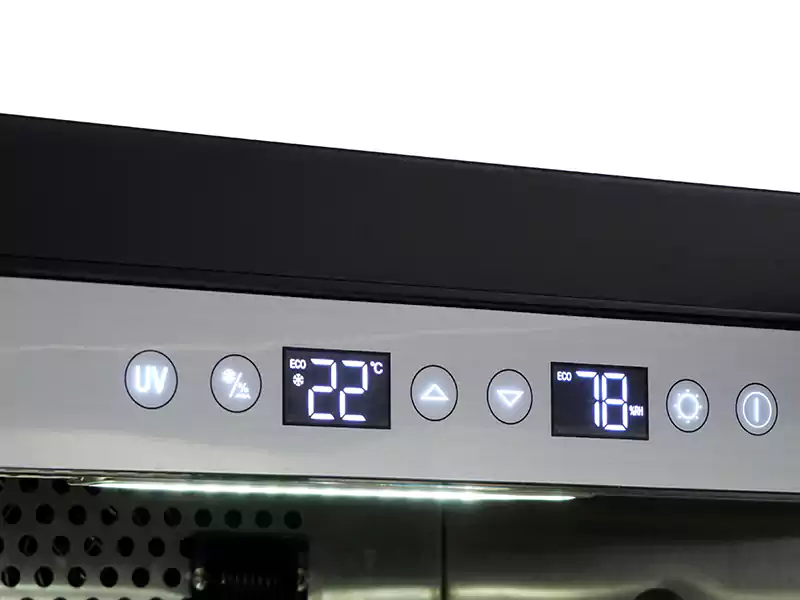
For commercial applications, consider the following practices.
1. Check the Equipment Before Loading
Confirm that the refrigerator is clean, operating correctly and ready for the intended process. Check the temperature and humidity controls according to the manufacturer’s instructions.
2. Monitor Actual Conditions
Use suitable monitoring instruments and do not rely exclusively on a setpoint displayed on the control panel. Where appropriate, verify measurements using properly maintained instruments.
3. Record Readings Consistently
Keep records of temperature and relative humidity according to your operating procedure. Consistent records can help identify unusual fluctuations and support process review.
4. Maintain Air Circulation
Arrange product and shelving according to the equipment instructions. Avoid loading practices that obstruct intended airflow.
5. Investigate Unexpected Changes
If readings move outside the approved operating limits, follow your established corrective-action procedure. Do not assume that restoring a display reading automatically resolves every product-safety or quality concern.
6. Keep the Cabinet Clean
Follow the equipment manufacturer’s cleaning instructions and your facility’s food-safety procedures. Environmental controls do not replace proper sanitation and hygienic product handling.
These practices support process control, but they do not by themselves establish that beef is safe. Commercial operators must follow applicable food-safety requirements and validated procedures.
How Do Temperature and Humidity Affect Dry Aging Results?
The purpose of controlling the environment is to create consistent conditions for the intended aging process.
However, the same cabinet settings do not guarantee identical results for every cut of beef.
Factors such as starting product quality, cut size, surface characteristics, air movement and aging duration can influence the outcome.
Moisture Loss
The surrounding environment influences moisture evaporation. Humidity and airflow are particularly relevant to how the surface dries.
Flavor Development
Dry aging can produce a more concentrated and distinctive beef flavor. The final flavor profile depends on multiple variables, not just one temperature or humidity number.
Product Yield
Moisture loss and trimming affect the amount of saleable product remaining after aging. These factors are important when commercial operators evaluate an aging program.
Repeatability
For a business, consistency between batches may be more valuable than pursuing a particular setting because it is described as ideal in a general guide.
The objective should be to establish an appropriate, documented process and use equipment capable of maintaining the required conditions.
What Should You Look for in a Commercial Dry Aging Refrigerator?
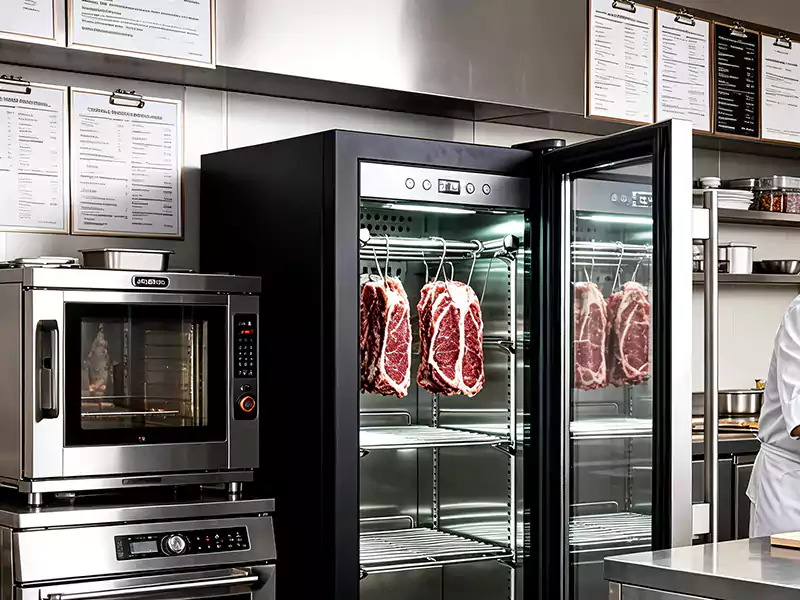
If you are sourcing a commercial dry age fridge, evaluate more than the advertised temperature range.
Temperature Control
Check the available operating range, control capability and suitability for your intended process.
Humidity Management
Confirm whether the equipment can monitor or control relative humidity and understand the limits of that capability.
Airflow Design
Ask how air is circulated and how the cabinet layout supports the intended loading configuration.
Monitoring and Controls
Review the control interface, sensor arrangement and any available monitoring features.
Capacity and Internal Layout
Choose a cabinet based on the expected product load, available installation space and required airflow—not volume alone.
Cleaning and Maintenance
Consider access for cleaning, routine maintenance requirements and the manufacturer’s instructions.
Technical Documentation
Request the current product datasheet, operating instructions and any applicable compliance documentation for the model and target market.
For commercial buyers, importers and private-label brands, these details are important when comparing equipment and planning a repeatable operation.
How Sunnai Dry Age Refrigerators Support Commercial Applications
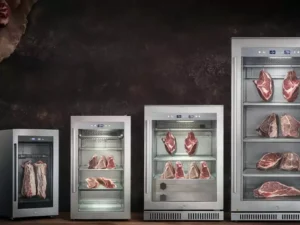
Sunnai offers commercial dry aging refrigerator models with different cabinet capacities and control configurations.
The currently published product range specifies an operating temperature range of approximately 2–14°C and relative humidity of approximately 50–85% RH, depending on the model and configuration.
These figures describe the equipment’s specified operating ranges. They should not be interpreted to mean that every point within those ranges is an appropriate aging setting for every cut or process. The target conditions must be determined from the specific equipment, validated procedure and applicable food-safety requirements.
When evaluating a Sunnai model, review the technical specifications and discuss your intended application with the team before selecting an operating program.
Explore our Commercial Dry Age Fridge range
If you are a distributor, importer or private-label brand, you can also learn more about our factory and OEM/ODM capabilities.
Based on the Above Point of View
The best temperature and humidity for dry aging beef cannot be reduced to one number that works for every operation.
Published research provides useful reference ranges, but actual practices and study results vary. Temperature, humidity, airflow and aging time need to be considered together, with operating targets selected for the specific equipment and validated process.
For commercial meat businesses, a purpose-built dry aging refrigerator can provide the controls needed to manage the intended environment. The next step is to evaluate the cabinet’s specifications, airflow design, monitoring capability and suitability for your application.




 EN
 AR
 RU
 FR
 IT
 KO
 JA
 ES
 TH